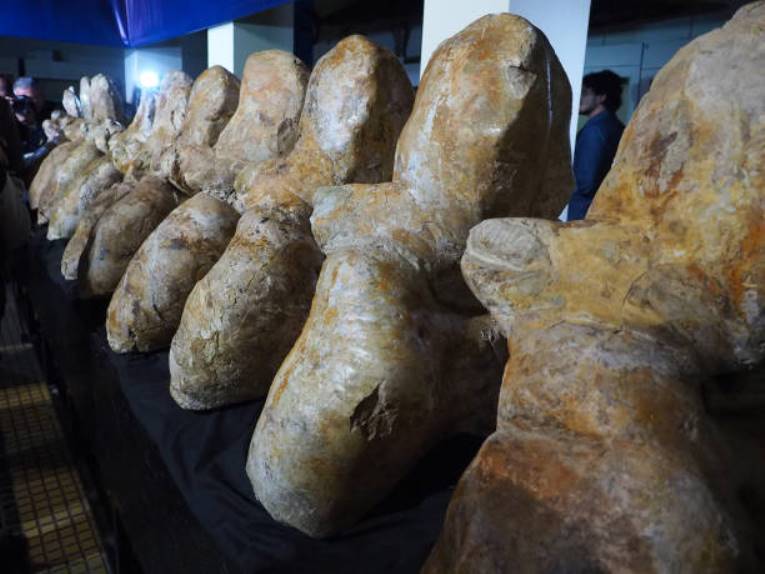
Scientists said on Wednesday that the biggest animal to have ever lived is believed to have been a huge whale that lived over 40 million years ago.
An article in the magazine “Nature” claims that the Perucetus colossus, or the enormous whale from Peru, was even larger than the blue whale, the current heavyweight champion.
Based on fossils discovered over a decade ago in the Peruvian desert, the recently disclosed results have only recently been identified as a hitherto undiscovered species.
The colossus, at 66 feet long, is not the longest or largest animal to have ever lived in the ocean; blue whales can reach enormous lengths of 100 feet.
However, the study stated that the recently found sea mammal was most likely the heaviest because to its sheer weight and bone density, weighing anywhere from 94 tons (85 metric tons) to 375 tons (340 metric tons). The largest blue whales that have been seen are thought to weigh 200 tons, or 180 metric tons.
The journal article stated that P. colossus is “a contender for the title of heaviest animal on record” because its estimated skeleton mass is greater than that of any known mammal or aquatic vertebrate.
According to a press release from the study’s lead author Giovanni Bianucci of the University of Pisa in Italy, “the body mass of this ancient cetacean may have been… nearly double that of the largest blue whales as well as more than three times that estimated over Argentinosaurus, which was one of the largest dinosaurs ever found.”
Years were spent excavating in the Ica desert, which is located near Peru’s southern coast. This region was originally under water and is well-known for its paleontological finds. The scientists were from many countries.
After some time, they managed to expose and remove 13 vertebrae, four ribs, and a hip bone. Over 220 pounds would have been the weight of each vertebrae.
The research team found it difficult to extract the bone fossils and to completely evaluate them using the standard techniques, which presented a significant difficulty.
Rather, they created a three-dimensional model of them using cutting-edge structured light scanning, then they bored inside.
This made it possible for them to determine the whale’s mass and size despite its partial skeleton.
The team may be able to date the species to the Eocene epoch, between 39.8 and 37.84 million years ago, based on dating of volcanic ash found at the site.
According to research team member Elisa Malinverno, at that time, other members of the cetacean family, which also includes dolphins and whales, were still “abandoning the terrestrial lifestyle in favor of a marine one.”
The findings suggested that the Perucetus colossus may have roamed about the ocean floor, grazing along the seabed like some sharks and current sea cows by using its hefty bones as ballast.
According to the Associated Press, paleontologist Hans Thewissen of Northeast Ohio Medical University, who was not involved in the research, stated, “It’s just exciting to see such an enormous giant animal that’s so different from anything we know.”
The oldest known four-legged cetacean that reached the Pacific Ocean and the earliest known ancestor of modern baleen whales were discovered by scientists in the Ica desert, one of the driest locations on Earth.