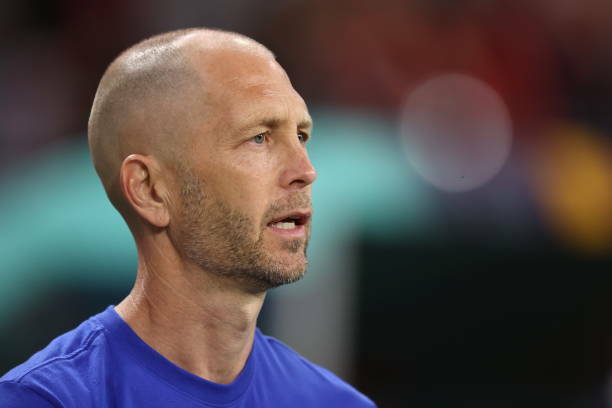
The United States met their minimum requirement for the 2022 World Cup, but a 3-1 loss to the Netherlands in the Round of 16 left many fans wanting more.
The loss made the USA’s all-time record five losses in six rounds of 16 matches at the FIFA World Cup. They remain in the knockout stages with just one win over Mexico in 2002.
In Qatar, the United States was the second-youngest team in the entire field, along with Mexico and Canada, with a view to building toward the 2026 World Cup hosted by the United States. Still, a positive performance was desired in 2022, and now the debate begins on how to rate the tournament as a whole.
With that comes questions of Berhalter’s position as head coach of the USMNT. Berhalter has brought many positive qualities to his role as head coach, but also glaring shortcomings. Will U.S. Soccer make the switch and start before the 2026 tournament, or will they give Berhalter a vote of confidence and support to get this team into a big next cycle?
Will the USA fire head coach Greg Berhalter?
With the USMNT now out of the 2022 World Cup, the United States head coach will now take time to evaluate his future, and so will the U.S. Soccer Federation.
Reviews will be conducted and reflection will be made as both parties consider how they wish to proceed.
Some national team federations, such as Belgium and the Netherlands, will make changes immediately after the World Cup ends, but American fans will have to wait for the decision to move their head man forward. Berhalter confirmed after the round of 16 loss that he would take “a few weeks” to determine his next course of action.
Berhalter on his future, doesn't say one way or the other if he wants to continue with USMNT: "In the next couple of weeks, I'll sit down and clear my head and think about what's next."
— Sam Borden (@SamBorden) December 3, 2022
Gregg Berhalter contract, salary with USA
In 2018, Berhalter signed a four-year contract that runs until the end of the 2022 World Cup, a relatively common timeframe for national team coaching contracts that often last a full World Cup cycle before requiring a review and extension, if earned.
Reports citing U.S. Soccer tax filings from 2021 suggest that Berhalter’s annual salary was just under $1.3 million per year, making him the highest-paid U.S. Soccer employee at the time.
After the World Cup, US Soccer will evaluate his performance and decide whether to re-sign as head coach for the next World Cup cycle or go in another direction. A detailed review of the USMNT’s performance in Qatar will almost certainly play a decisive role in that call.
Should the United States fire Greg Berhalter?
After falling in the Round of 16, there’s an argument to move on from Greg Berhalter, but there are also plenty of reasons to keep him as the head man.
Here’s the argument for and against changing head coaching. Whichever side U.S. Soccer lands on, they must make a decision four years before the most important World Cup in the country’s history.
The argument for retaining Greg Berhalter
In four years, Greg Berhalter has completely transformed the roster of players on the US National Team from a talent and tactical standpoint. Berhalter took pleasure in playing the role of a nimble underdog for a nation that not only believes they can consistently win against bigger nations, but has the ability to do so.
The most important contribution from Berhalter to the national team comes off the field. Berhalter’s player recruitment was almost unbeatable, securing the commitment of many talented, young dual-nationals such as Younes Musah, Anthony Robinson, and Sergino Dest, who are now essential components of the team. Still Gabriel Slonina, Ricardo Pepi, and Malik Tillman project to be important players over the next four years and beyond. In 2022, player recruitment is very important, and Berhalter is exceptional in that regard.
The 49-year-old has also been successful at the top of CONCACAF football. He engineered one of the greatest results in U.S. soccer history against rival Mexico, becoming the first coach to beat Mexico three times in a calendar year. He won the inaugural CONCACAF Nations League, the 2021 Gold Cup with a largely B-team squad, and managed to achieve key results amid a very tough CONCACAF qualification scene.
Berhalter also had a good tactical performance in the 2022 World Cup. He earned open praise from all four opposing managers, teaming up with the American to consistently catch the opposition off guard with his trademark high press along with his game plan and tactical approach.
Finally, Berhalter has cultivated a strong locker room culture and maintained a core of players who have developed into top-level international players with a strong off-field bond. There have been a few slip-ups during the World Cup, including discontent surrounding Gio Reyna, but overall Berhalter has maintained a positive relationship within the dressing room.
The current US head coach sports many positive attributes, and making a change would sacrifice significant advantages on several fronts.
The rationale for firing Greg Berhalter
While Berhalter has shown clear positives, there are also some glaring weaknesses that have failed to show improvement during his tenure.
First and foremost, Berhalter has been heavily criticized for his player selection and lineup choices, some without merit but with some significant evidence. In particular, Berhalter’s decisions in the striker position at the World Cup proved costly for their chances of advancing to the Round of 16. All three strikers struggled to prove effective in front of goal, and Josh Sargent and Haji Wright both had good moments, with neither really threatening the opposition net, and Jesus Ferreira fumbled his chances against the Netherlands.
Additionally, Berhalter’s second half approach to games has been extremely concerning. The U.S. proved very good under Berhalter in the first half, but seemed to consistently fail in concentration and threat. Often, Berhalter’s teams are left under siege as they cling to life over time. His replacements missed the mark, and he failed to recognize tactical adjustments by opposing head coaches and make his own tweaks.
This was on display at the World Cup as Berhalter was off the coach in the second half of consecutive games, with Wales, Iran, and the Netherlands developing mid-game tactical changes that Berhalter failed to recognize, exposing the US. After the Round of 16 defeat, Netherlands head coach Louis van Gaal specifically pointed out that the U.S. had not adapted its plan of attack, which focused on exploiting wide areas with wing-backs Denzel Dumfries and Daley Blind.
USMNT under Berhalter often doesn’t have a contingency plan. Subs are mostly man for man unless they’re in a desperate situation. https://t.co/iPfRdutTu6
— Nico Cantor (@Nicocantor1) December 3, 2022
National team head coaches historically rarely last more than a four-year cycle, unless they achieve great success, as federations often feel the need for a new voice. Four years is an eternity in coaching in any sport. If U.S. Soccer feels it is impossible to correct these weaknesses, and another person can do better in these moments, they may think about making a change.