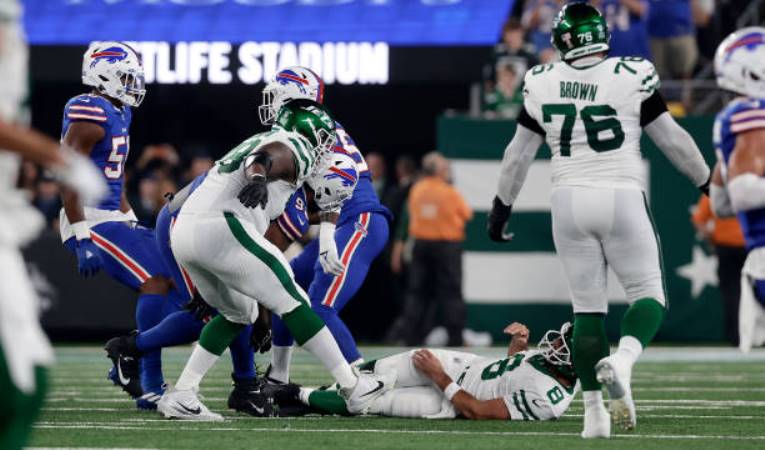
The issue of the safety of artificial turf was brought up again after New York Jets quarterback Aaron Rodgers went down on the field at Metlife Stadium with a season-ending Achilles tendon tear during the team’s opening game. And while the NFL has insisted that turf fields are just as safe as grassy ones, new data made available to NBC News indicates that injuries tend to be higher in NFL stadiums with synthetic flooring.
Seven of the ten stadiums with the highest injury rates from 2017 to 2022 featured artificial surfaces, according to statistics from the sports analytics firm Sports Info Solutions, which offers data and analysis to professional sports clubs and other industry groups.
This data supports research from the NFL Players Association, which found that from 2015 to 2022, artificial grass had greater injury rates.
Additional Sports Info Solutions data revealed that athletes were more likely to sustain injuries on synthetic grass that forced them to miss time from play and discovered more turf injuries affecting a variety of body regions.
The greater injury rates are widespread, not just in the NFL. According to a study by Washington University in St. Louis, high school athletes from 26 different schools were 58% more likely to get hurt on artificial turf than on actual grass.
The risk of injury was clearly increased, “especially in athletes who participated in football, soccer, and rugby,” according to Dr. Derrick Knapik, an orthopedic sports medicine specialist at Washington University in St. Louis and one of the study’s authors.
Knapik warned that high school players might be more prone to injuries due to their lack of skill and conditioning, but he also pointed out that artificial turf has a stickiness that might snag the foot in a way that real grass might not.
Knapik cautioned, “If that foot sticks, that’s going to increase the risk of injuries to the foot and ankle, as well as the knees and possibly the hip and torso.”
When the NFL was contacted for comment, Jeff Miller, its executive vice president in charge of player health and safety, offered a statement.
“There are several factors that affect the number of injuries at every stadium, and the playing surface is just one of them. A player’s pose or movements, the sort of contact made during the play, their injury history, the type of cleats they were wearing, and other factors can all contribute to a particular injury. said Miller. The NFL and the NFLPA have jointly designated specialists and are actively working together to reduce injury rates on all types of surfaces.
The NFLPA declined to comment, but the union’s president, JC Tretter, previously referred to grass fields as being “significantly safer” than artificial turf fields.
Experts concur. Raoul Reiser II is an associate professor of health and exercise science at Colorado State University. His research focuses on performance in sports and injury risk when the foot meets the ground. “I am in the camp which a good grass area is the gold standard that we are working to get artificial turf to emulate,” Reiser II said.
“I agree with the NFLPA’s reading of the injury statistics that artificial turf has a greater risk of lower extremity injuries than does real grass. I also trust them when they tell that playing on artificial turf leaves them feeling more fatigued and painful than playing on grass.