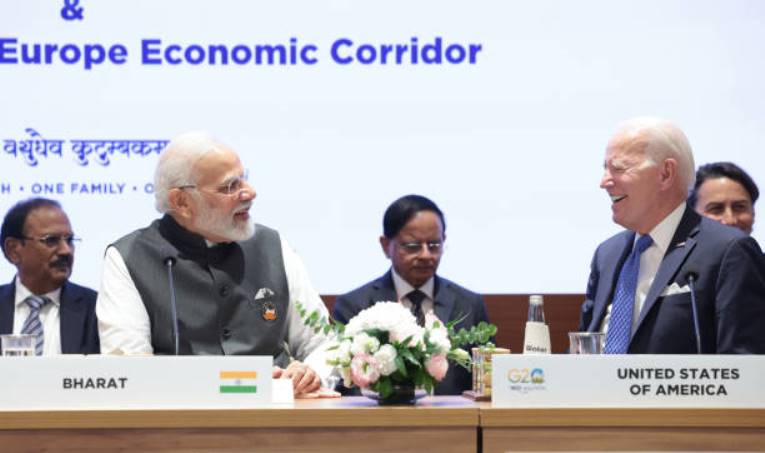
The moment President Joe Biden walked off Air Force One and onto Indian land if showing up is one of life’s basic precepts, he may have outdone his competitors.
The presidents of the United States’ two greatest geopolitical adversaries, China and Russia, chose not to attend this week’s Group of 20 meeting in New Delhi; this is a point that Biden administration officials have been pleased to make.
In the Indo-Pacific, Biden seeks to counterbalance Chinese influence while increasing pressure on Russia to conclude its protracted conflict with Ukraine. Both are difficult. However, the Biden administration hopes that the rest of the world will recognize the symbolism unfolding at China’s doorstep: While peers Xi Jinping of China as well as Vladimir Putin of Russia opted out, Biden went 7,500 miles to further his foreign policy vision despite his wife testing positive for Covid on the eve of the meeting.
At a news briefing on Saturday, Jonathan Finer, the White House’s deputy national security adviser, stated that “the United States is concentrating on the reality that President Biden is here, and he’s rolling up his sleeves, with the rest of the G20 nations as well as partners to produce real results.”
Although Xi and Putin are the only people with complete decision-making authority in the totalitarian systems they oversee, both China and Russia sent officials to the G20 summit. The absence of Putin is simpler to comprehend. The United States, the United Kingdom, France, and other Western nations have pleaded with him to withdraw troops and leave Ukraine, so if he were to arrive, he would be met by two days of resounding denunciation.
Foreign policy experts are perplexed by Xi’s decision to forgo the summit, the first time he has done so since assuming office ten years ago. He recently traveled to South Africa for a meeting with several other countries, including India. Missing the G20 would seem to be a missed opportunity at a time when the U.S. and China are trying to gain leverage over one another by fortifying partnerships.
Though there are many ideas, U.S. authorities were unable to explain why Xi did not appear. He has a domestic economic crisis that requires his attention. China is transitioning from the lockdowns of the Covid period while dealing with record-high young unemployment.
According to Yun Sun, Director of the China Program at the Stimson Center, the G20 is “not China’s top priority because China has bigger domestic fish to fry.”
Analysts speculated that Xi may have also sought to insult Prime Minister Narendra Modi, over whom he has a border conflict.
John Bolton, a former ambassador to the UN and national security adviser in the Trump administration, predicted that Modi would perceive it as a smack in the face in his home country. “I find it difficult to see why Xi Jinping would take that chance. The flight is brief. Has there been a catastrophe at home or is there another issue?
The absence of Xi from the meeting reduces the prospect of a resolution to the issues over trade, South China Sea navigation, and Taiwan’s status as a self-governing island by preventing the leaders present from meeting with the leader of the second-largest economy in the world.
If China is absent from a discussion of the global supply chain, for example, what supply chain are we discussing about? It will undoubtedly make any consensus-building more challenging. said Sun.
The fact that Xi would not be present at the summit “disappointed” Biden, he said last week. He had a private meeting with Xi last year outside the G20 summit in Indonesia. Since then, the Chinese surveillance balloon that traveled across the United States has strained relations between the two leaders. In June, during a fundraiser, Biden described Xi as a “dictator.”
The Biden administration was also concerned that China may give Russia access to weaponry, a scenario that could make the war more favorable to Putin. China has declared that it won’t supply any side in the fight with weapons. According to U.S. officials, Biden argued at an early session on Saturday that the war in Russia is hurting not only Ukraine but also other G20 nations through greater hunger and economic dislocation.
Later in the day, Biden joined Modi to introduce a number of ambitious new infrastructure initiatives targeted at assisting developing countries. The focal point is a proposed “economic corridor” that would use rail and sea networks to link Europe, the Middle East, and India.
In a more kid-friendly version of the words he previously used as vice president to celebrate the passage of the health care reform law, Biden added, “This is a big deal.”
The larger program, known as the Partnership on Global Infrastructure & Investment, is Vice President Biden’s response to China’s “Belt and Road Initiative,” which it has used to increase its influence over smaller countries that require investment funds. Biden and U.S. allies hope to sever some weaker nations from China by providing them with a funding source that does not bind them to Beijing. To do this, they are gathering public and private funds.
Biden might have gotten more attention for his ideas because neither Putin nor Xi were present, which would not have been the case otherwise.
Biden essentially has the stage to himself, according to Daniel Russel, a former Obama administration assistant secretary of state. “The enormous focus that would have been placed on Putin or Xi Jinping if they had attended has been diminished. He is exempt from competing against Putin and Xi Jinping. And he is free from having to focus on how he will handle them.
For Biden, the summit hasn’t been entirely successful. The leaders produced a unified statement regarding Russia’s invasion of Ukraine that is far more mild-mannered than the vehement statement made last year.
The joint statement from the G20 meeting in Indonesia in 2022 specifically mentioned Russia, expressing the leaders’ “strongest condemnation” of the Russian Federation’s actions against Ukraine and their “demands for its unconditional, complete, and total withdrawal from Ukrainian territory.” The new policy merely states that “all states must refrain from any threat or use of force in search of territorial acquisition over the sovereignty, territorial integrity, or political independence of any state.”
In addition, Biden could encounter criticism for shaking hands with Mohammed bin Salman, the de facto ruler of Saudi Arabia, on Saturday. At the conclusion of the meeting dedicated to the new infrastructure program, they embraced it.
A U.S. intelligence report that was made public in the first month of Biden’s term stated that bin Salman gave the go-ahead for the killing of critical writer Jamal Khashoggi at a Saudi consulate in Istanbul in 2018. (The Saudis denounced the intelligence information in a statement as being “false.”)
Biden promised to declare Saudi Arabia a “pariah” while running for office in 2020 but has since worked to establish a solid working relationship with the nation, partly to maintain some control over gas pricing.