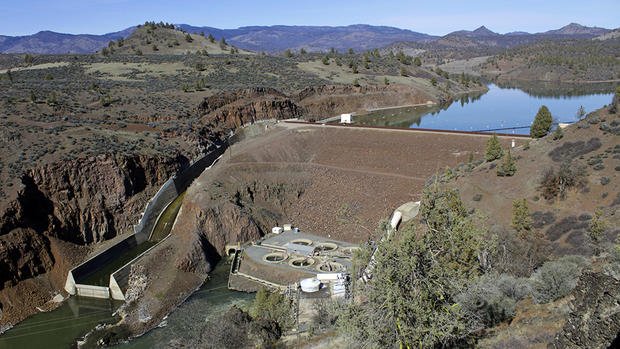
U.S. regulators on Thursday approved a plan to dismantle four dams on a California river and open up hundreds of miles of salmon habitat in what will be the world’s largest dam removal and river restoration project when it goes ahead.
The Federal Energy Regulatory Commission’s unanimous vote on the Lower Klamath River dams is the last major regulatory hurdle and the biggest milestone for the $500 million demolition proposal. The project would return the lower half of California’s second-largest river to a free-flowing state for the first time in more than a century.
Native tribes that depend on the Klamath River and its salmon for their livelihoods have been a driving force in bringing down dams in the wild and remote region that straddles the border of California and Oregon. Barring any unforeseen complications, Oregon, California, and the organization formed to oversee the project will accept the license transfer and could begin removing the dam this summer, supporters said.
“The Klamath salmon are coming home,” Yurok President Joseph James said after the vote. “The people have won this victory and with it we fulfill our sacred duty to the fish that have sustained our people since the dawn of time.”
The dams produce less than 2% of PacifiCorp’s power output — enough to power about 70,000 homes — when they’re running at full capacity, utility spokesman Bob Gravely said. But they often run at much lower capacity because of low water in the river and other issues, and the deal that paved the way for Thursday’s vote was ultimately a business decision, he said.
PacifiCorp was required to invest hundreds of millions of dollars under environmental regulations in fish ladders, fish screens, and other conservation upgrades that were not previously in place when the old dams were built. But with the deal approved Thursday, the utility’s cost is capped at $200 million, with another $250 million from California’s voter-approved water bond.
“We’re closing coal plants and building wind farms and it all has to add up in the end. It’s not one-to-one,” he said of the upcoming dam demolition. “You can make that power by changing the way you operate the rest of your facilities or by saving energy efficiency in a way that your customers are using less.”
The approval of the order to surrender the dam’s operating license is the foundation of the most ambitious salmon restoration plan in history and the scope of the project — measured by the number of dams and the amount of river habitat reopened to salmon — makes it the largest. of its kind in the world, said Amy Sours Kober, spokeswoman for American Rivers, which advocates for dam removal and river restoration.
More than 300 miles of salmon habitat in the Klamath River and its tributaries will benefit, she said.
The decision is in line with a trend across the U.S. to remove older and older dams as they come up for license renewal and face the same government-mandated upgrade costs as the Klamath River dams.
Across the U.S., 1,951 dams have been breached as of February, including 57 in 2021, American Rivers said. Most of them have come down to the age of convenience in the last 25 years and have come for re-licensing.
Commissioners called Thursday’s decision “significant” and “historic” and spoke of the importance of taking action during National Native American Heritage Month because of the importance of restoring salmon and reviving the river, which is at the heart of many tribes’ cultures. in the field.
“At a time of this great need for zero emissions, some people may ask, ‘Why are we removing dams?’ First, we have to understand that this doesn’t happen every day … many of these projects were licensed many years ago when there wasn’t much attention to environmental issues,” said FERC Chairman Richard Glick. “Some of these projects have a significant impact on the environment and a significant impact on fish.”
Glick added that, in the past, the commission has not considered the impact of energy projects on tribes, but that was a “very important element” of Thursday’s decision.
Members of the Yurok, Karuk, and Hupa Valley tribes and other supporters lit a bonfire on a remote Klamath River sandbar via a satellite uplink as a symbol of their hope for the river’s renewal.
“I understand some of those tribes are watching this meeting today at the (river) bar and I raise a toast to you,” Commissioner Willie Phillips said.
The Klamath Basin watershed covers more than 14,500 square miles (37,500 square kilometers) and the Klamath itself was once the third-largest salmon-producing river on the West Coast. But dams built between 1918 and 1962 essentially cut the river in half and prevented salmon from reaching the spawning grounds upstream. As a result, salmon runs have been declining over the years.
The smallest dam, Copco 2, could come down as soon as this summer. The remaining dams — one in southern Oregon and two in California — will be slowly lowered by early 2024, with the goal of returning the river to its natural state by the end of that year.
The plan to remove the dam has not been without controversy.
Homeowners on Copco Lake, a large reservoir, strongly oppose the demolition plan, and ratepayers in rural counties surrounding the dam worry that taxpayers would shoulder the cost of any overruns or liability issues. Critics also believe that dam removal will not be enough to save salmon because of the changing ocean conditions the fish encounter before returning to their native rivers.
“The whole question is, does it add to the increased production of salmon? It adds to what’s going on in the ocean (and) we think it would be a wasted effort,” Richard Marshall said. Siskiyou County Water Users Association. “No one has tried to solve the problem by considering the current situation without removing the dam.”
US regulators raised flags about the potential for cost overruns and liability issues in 2020, nearly killing the proposal, but Oregon, California, and PacifiCorp, which operates hydroelectric dams and is owned by billionaire Warren Buffett’s company Berkshire Hathaway, teamed up to add another $50. million in contingency funds.
PacifiCorp will continue to operate the dams until demolition begins.
In 2012, the largest US dam to date was removed, removing two dams on the Elwha River on Washington’s Olympic Peninsula.