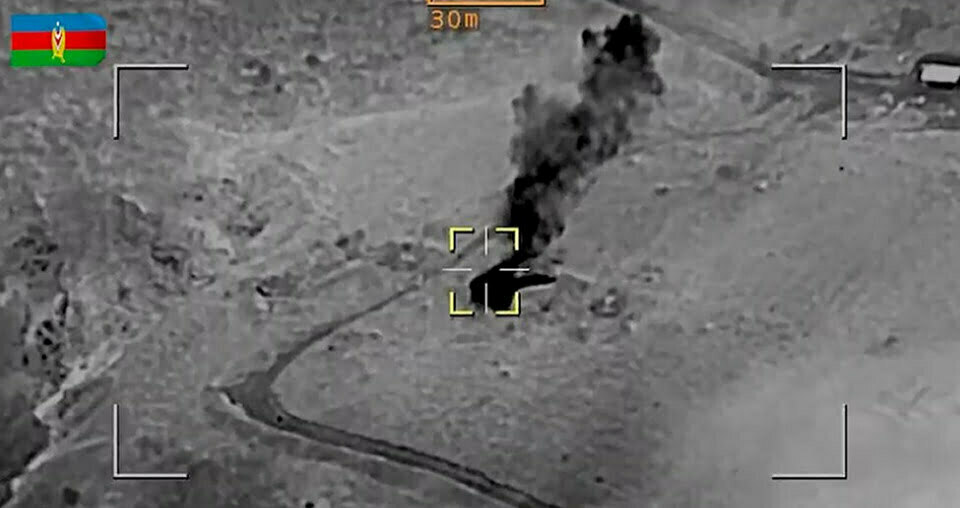
According to officials from both sides, an agreement on a cease-fire between Azerbaijani and Armenian forces on Wednesday put an end to two days of combat in the separatist Nagorno-Karabakh territory, which has been a flashpoint for decades.
The intensity of hostilities in the area “has decreased drastically,” according to Armenian Prime Minister Nikol Pashinyan, an hour after the declaration of a truce. When separatist leaders declared they were handing over their weapons, Azerbaijani authorities claimed they had stopped the military action that had been started the previous day.
On Thursday, the disputing parties agreed to hold discussions over the “reintegration” of the area into Azerbaijan. This was widely regarded as a win for Baku, along with pledges to lay down armaments.
Azerbaijan launched heavy artillery fire on Armenian positions in Nagorno-Karabakh on Tuesday. Nagorno-Karabakh is a hilly territory that is a part of Azerbaijan and was occupied by ethnic Armenian forces during a separatist conflict in the 1990s.
The most recent conflict apparently resulted in scores of deaths and injuries. The clashes further worsened an already dire humanitarian situation for locals who had been enduring food and medicine shortages for months due to Azerbaijan’s road blockade of Nagorno-Karabakh to Armenia.
Azerbaijan and Armenia have been engaged in a conflict over the area since the fall of the Soviet Union, and the escalation fueled fears that a full-scale war could break out in the area again. The most recent major battle took place over a six-week period in 2020 when Azerbaijan retook territory that had been lost during the earlier separatist conflict.
Powerful regional actors like Russia and Turkey have been sucked into the conflict for a long time. Turkey supported Azerbaijan, while Russia acted as a mediator and arranged the armistice that put an end to the 2020 combat. In reality, its peacekeeping troops are tasked with keeping an eye on that ceasefire, and both sides acknowledged on Wednesday that they contributed to the current arrangement.
However, it did not specify how many or if the deaths occurred before or after the start of the cease-fire. On Wednesday, the Russian Defense Ministry confirmed that several of its peacekeepers had died.
More than 3,100 civilians, according to the ministry, were evacuated by the peacekeeping force. They were transported into the contingent’s “base camp,” it had earlier stated, without specifying where exactly it was.
According to the agreement, the local defense forces will be disarmed as well and Armenian military units and equipment will be removed from Nagorno-Karabakh, according to the Defense Ministry of Azerbaijan. Pashinyan claimed that while his administration was not involved in the discussions or negotiations surrounding the agreement, it “has taken note” of the choice made by the separatist authorities in the area.
The rebels’ admissions revealed their recent weakened position and that of their Armenian sympathizers.
According to Thomas de Waal, a senior scholar at the Carnegie Europe think tank, Armenia has very little influence in the breakaway area after losing the war in 2020 and most recently, control of the single route connecting the country to Nagorno-Karabakh. Azerbaijani forces were “probably not a match for the separatist forces,” according to De Waal, who noted that the forces were made up of thousands of men who had received inadequate supplies.
Russia and Armenia both seemed to withdraw from the fight at the same time.
While Moscow dismissed such assertions, Pashinyan said that Russia was responsible for protecting the security of Armenians in the area.
According to Dmitry Peskov, a spokesman for the Kremlin, Azerbaijan was in fact acting within its own borders on Wednesday.
Later, Vladimir Putin, the president of Russia, said, “I hope that we can accomplish de-escalation and solve this crisis by peaceful channels.
A strategy is in place to reintegrate the Armenian population of the region into Azerbaijani society, according to Hikmet Hajiyev, a presidential assistant in Azerbaijan. Baku is also “ready to listen to the Armenian population of Karabakh concerning their humanitarian needs.”
Azerbaijan listed a long number of grievances when it announced what it called a “anti-terrorist operation” action on Wednesday, accusing Armenian forces of targeting its positions in the area, setting land mines, and carrying out acts of sabotage.
The prime minister of Armenia claimed that Azerbaijan’s main objective is to incite conflict with it, while the foreign ministry of Armenia denied that any of its troops or weapons are in Nagorno-Karabakh.
Although ethnic Armenian officials in Nagorno-Karabakh stated that Azerbaijani forces were exclusively shelling military targets, they reported that Stepanakert, the region’s capital, and several villages were “under intense shelling” on Tuesday.
Every few minutes on Wednesday morning prior to the cease-fire, explosions resonated across Stepanakert, some farther away and others closer to the city. Many Stepanakert residents chose to remain in shelters at least through the end of Wednesday even after the truce was declared and the city could no longer hear the shelling.
The city was evidently severely damaged, with shop windows blown apart and vehicles pierced, seemingly by shrapnel.
Edmon Marukyan, the general representative of Armenia, published a picture of people gathered at what appeared to be the Stepanakert airport. Whether they intended to depart the area was unclear, and The Associated Press was unable to independently confirm the photo’s provenance.
According to Geghan Stepanyan, the human rights ombudsman for Nagorno-Karabakh, 32 people—including seven civilians—were murdered and more than 200 others were injured. He had stated that 11 children were among the injured and that one youngster was among the dead.
One civilian was killed, according to the Azerbaijani Prosecutor General’s Office, after Armenian forces opened fire on Shusha, a city in Nagorno-Karabakh that is under Azerbaijani control.
It was impossible to independently verify the statements.
On Tuesday, tens of thousands of protestors gathered in the heart of Yerevan, the nation’s capital, blocking streets and pleading with the government to stand up for Armenians in Nagorno-Karabakh. Some engaged in conflict with officers, who allegedly fired stun grenades.
Following the announcement of the cease-fire deal on Wednesday, protesters reportedly started congregating there once more. The protesters screamed anti-government chants and called for Pashinyan’s removal, according to a Tass report.