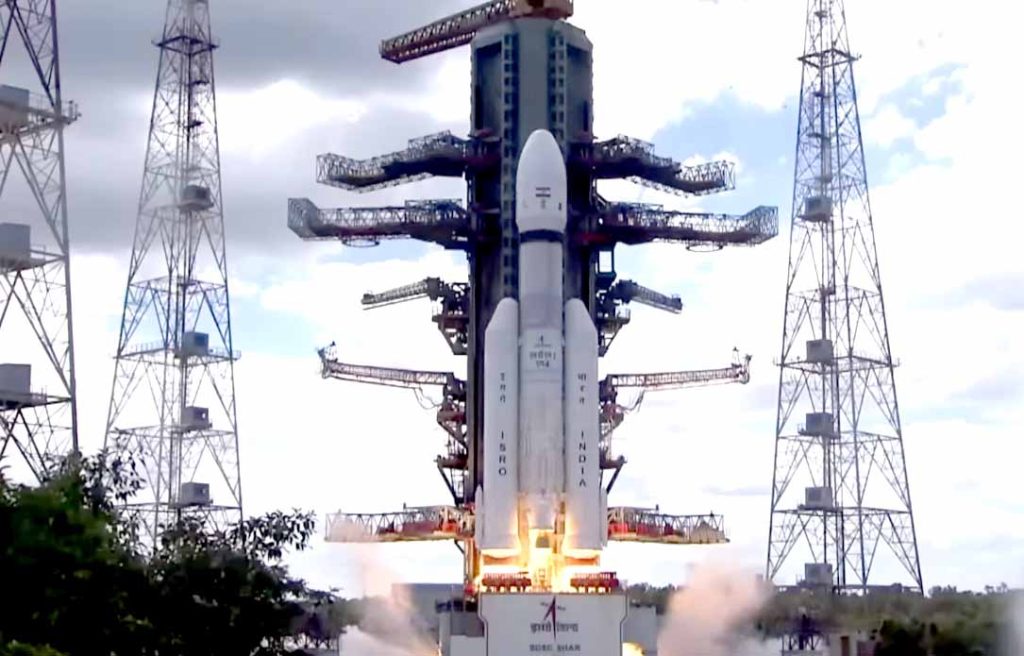
With its Moon mission becoming the first to set foot near the lunar south pole, India has created history.
With this, India joins the US, the former Soviet Union, and China as the only other nations to successfully conduct a soft landing on the moon.
At 18:04 local time (12:34 GMT), the Vikram lander from Chandrayaan-3 successfully made landfall.
Prime Minister Narendra Modi declared that “India is now on the Moon” as celebrations erupted all throughout the nation.
“We have succeeded where no other nation has. It’s a happy occasion,” he continued. From South Africa, where he is attending the Brics conference, Mr. Modi was viewing the event live.
With its Moon mission becoming the first to set foot near the lunar south pole, India has created history.
With this, India joins the US, the former Soviet Union, and China as the only other nations to successfully conduct a soft landing on the moon.
At 18:04 local time (12:34 GMT), the Vikram lander from Chandrayaan-3 successfully made landfall.
Prime Minister Narendra Modi declared that “India is now on the Moon” as celebrations erupted all throughout the nation.
“We have succeeded where no other nation has. It’s a happy occasion,” he continued. From South Africa, where he is attending the Brics conference, Mr. Modi was viewing the event live.
On Wednesday, stressful moments occurred before the touchdown as the lander, dubbed Vikram after Isro founder Vikram Sarabhai, started its perilous fall while carrying the 26-kg rover known as Pragyaan (the Sanskrit word for wisdom) inside its belly.
The lander’s speed was progressively decreased from 1.68 km/s to virtually 0 km/s, allowing it to land gently on the moon’s surface.
The six-wheeled rover will crawl out of the lander’s belly in a few hours, once the dust has settled, and travel among the rocks and craters on the Moon’s surface, gathering important data and photographs to be returned to Earth.
What will happen to India’s Moon mission next?
The search for water-based ice, which could one day enable human habitation on the Moon, is one of the mission’s main objectives. Additionally, it might be used to refuel spacecraft traveling to Mars and other far-off planets. There is a sizable surface region that remains permanently under darkness, according to scientists, and it may contain water ice stores.
Both the lander and the rover are equipped with five scientific equipment that will assist researchers in learning more about the Moon’s surface’s tectonic activity, atmosphere, and physical properties.
An official informed the BBC that the rover is flying the Indian flag and that the Isro logo and insignia are engraved on its wheels to make marks on the lunar surface when it walks on the moon.